One of the ways that Tracy Community Connections Center aims to provide stability for our unhoused clients in Tracy and Stockton is by seeking temporary accommodation in local hotel rooms. This is more easily done with ReloShare, which offers a program called Safe Stays. Reloshare specifically serves social service agencies like TCCC who are seeking to find emergency or temporary housing for our clients.
Safe Stays
Safe Stays is a hotel booking platform similar to Expedia or Hotels.com, but specifically designed for our unhoused clients. When our clients need emergency or temporary housing, we use Safe Stays to instantly book safe hotel accommodations.
Safe Stays saves our support team a great deal of time when it comes to searching, selecting and booking rooms. Like other hotel booking platforms, all of the options are gathered in one place so that our team doesn’t have to call around lots of different hotels to check availability and negotiate rates. Safe Stays presents all the available options and rates suitable for our clients who are in need of emergency or temporary housing.
With a hotel stay offering the foundation block of safe, reliable shelter for the interim, our case managers can more easily help clients to find permanent housing. Safe Stays partners with over 15,000 hotels nationwide, offers 24/7 check-in support, and allows domestic violence victims to check in under an alias for added safety. These thoughtful services are crucial for our clients. ReloShare sends TCCC one consolidated bill for all of the hotel rooms used by our clients which saves our team the task of tracking down individual receipts all day long! ReloShare kindly offers use of their booking services for free so that we can dedicate more of our resources towards helping clients directly.
We’re proud to share the Sierra Health Responsive Grants Program Report, which highlights the impact of our Tracy Laundry & Social Support Program, a key part of our mission to reduce homelessness and improve well-being in our community.
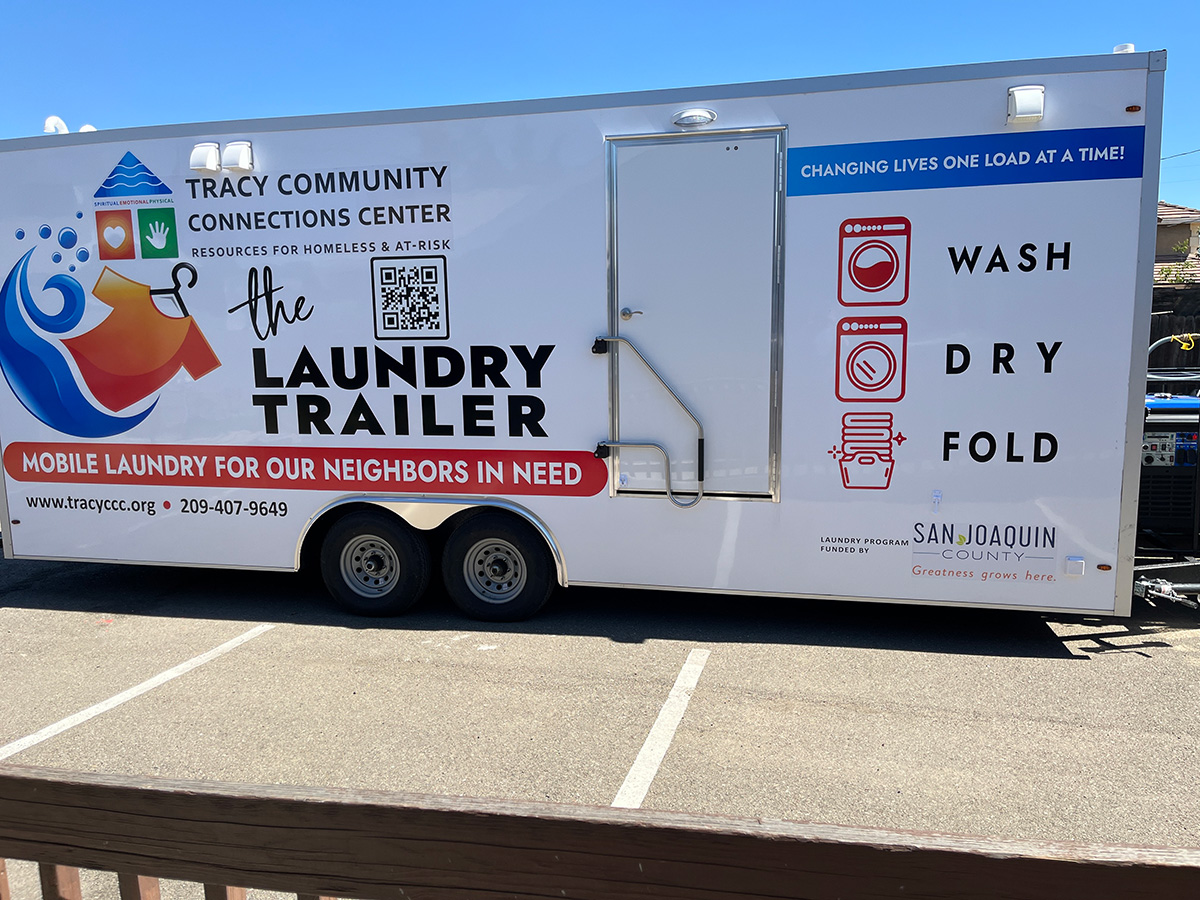
Through this grant, valued at $9,999.25, Tracy Community Connections Center (TCCC) has expanded access to clean laundry, hygiene, and case management services for unhoused individuals and families in Tracy. By providing laundry services twice a week, alongside our shower program, we’re helping to improve physical and mental health, reduce skin infections, and promote social connection.
Our laundry trailer has also become a powerful point of engagement—allowing our team to connect clients to housing, food, employment, and healthcare services. A large portion of this work is supported by our Street Outreach Team and Case Managers, who provide immediate assistance and long-term support.
We’re especially proud that our program reaches diverse members of the community. In 2023, 65% of the individuals we served were non-white, and 26% of Tracy’s unhoused population identifies as Black/African American, despite representing only 7.2% of the city’s population. Addressing these disparities remains a central focus of our work.
Thanks to Sierra Health’s support, we’ve been able to make a tangible difference, offering clean clothes, restored dignity, and a pathway toward stability.
Read the full Sierra Health Responsive Grants Program Report below to learn more about the outcomes and ongoing impact of this initiative.
If you or someone you know is experiencing homelessness in Tracy, help is available. Tracy Community Connections Center (TCCC) partners closely with local shelters and housing programs to connect individuals and families to safe, stable places to stay, whether that’s for a few nights or several months. Below is an overview of the main shelter options in Tracy, along with additional resources across San Joaquin County.
The City of Tracy’s Temporary Shelter provides short-term housing for adults in need of immediate assistance. Designed as a low-barrier shelter, it removes many of the typical entry requirements that can prevent people from getting help, meaning individuals don’t need to be sober or meet strict conditions to stay.
Each guest receives case management, housing navigation support, and access to community resources. The goal is simple: to help participants move from crisis to stability as quickly as possible. Stays are temporary, typically lasting until permanent or transitional housing becomes available.
McHenry House offers a supportive and family-focused environment for parents and children who have lost housing. Each family is given a private room and access to case management, parenting support, and life skills classes to help them regain stability.
The shelter typically allows families to stay for 30-60 days, depending on their progress toward housing and employment goals. Participation in a case plan and commitment to sobriety are required, ensuring that families have the structure and support they need to rebuild safely.
The Emerson and Rochester Houses provide longer-term transitional housing for men who are committed to sobriety and self-sufficiency. These homes offer a structured, sober living environment with daily routines, support groups, and life skills training to prepare residents for independent living.
Residents often stay between six months to a year, depending on their individual recovery goals and housing readiness. The Coalition of Tracy also connects participants with employment assistance, counseling, and permanent housing resources to support long-term success.
Shelters in San Joaquin County
If local shelters in Tracy are at capacity, there are additional options throughout San Joaquin County:
St. Mary’s Community Services– The largest emergency shelter in the county, serving individuals, families, and veterans with meals, case management, and housing assistance. (Note: Stockton Shelter for the Homeless merged its services with St. Mary’s)
Hope Ministries, Inc. (Manteca) – Shelters and housing options for women and children who have been displaced for up to 60 to 90 days. Offering case management, counseling, and mental health referrals.
Gospel Center Rescue Mission (Stockton) – Offers faith-based residential recovery programs, emergency shelter, and transitional housing for men, women, and families.
Family Promise of San Joaquin County – Focuses on helping families with children transition from homelessness to stable housing through short-term shelter and case management.
Anything missing from this list? Info that needs to be updated? Any questions about how Tracy Community Connections can help? Please get in touch with Carrie, our Executive Director at [email protected] or call TCCC at (209) 407-9649.
At Tracy Community Connections Center (TCCC), we’ve always known the need for support in our community was significant, but the past year has shown us just how quickly that need can grow. In the first six months of 2025, the number of homeless people seeking help has more than doubled compared to last year.
From January through June of 2023, TCCC served 548 clients. That number rose to 837 in the same period of 2024. But in just the first half of 2025, we served 1,954 clients. “Just straight numbers-wise, that’s kind of alarming,” said our Executive Director, Carrie Grover. “Just looking at that there is obviously something going on. I’m glad we’re here and that people are aware of us and coming to receive help but there is definitely an increase in need.”
We believe much of this increase is tied to rising housing costs and evictions. “We just aren’t keeping up with housing costs. We’ve seen the increase in mortgage rates — but I think a lot of it comes down to wages and housing costs, that’s just my best guess. It seems to be an affordability issue,” Grover explained.
At TCCC, our core programs continue to meet those needs: showers three days a week at New Heart Community Church, laundry services twice a week at Redemption Road Church, and Street Outreach every weekday providing food, hygiene kits, blankets, and transportation to appointments or housing placements. At our office, our case managers work one-on-one with clients on housing applications, rental assistance, and eviction prevention. “We’re trying to keep people who are housed, housed, and then people who are unhoused we’re trying to get them housed,” Grover said. “Whatever it is, my case managers will walk with them one-on-one, identifying their barriers to housing, and ultimately the goal is to get them in and keep them housed.”
Despite hiring additional staff, our team of 12 continues to face an overwhelming demand. “For the one family we get housed the next day a new one pops up, it does feel like we’re just treading water sometimes,” Grover noted. The challenge is compounded by lost federal funding, including cuts to the Emergency Food and Shelter Program, and ongoing concerns about Medi-Cal reductions.
Still, the work continues. Our partnerships with Tracy PD’s Familiar Faces Program, Community Medical Centers, and SJ Cares allow us to connect people with medical and behavioral health care while addressing immediate needs. Yet Grover emphasizes that homelessness isn’t always visible: “What we have seen is the city has done a good job of cleaning up the encampments but that necessitates people going elsewhere… couch surfing, living in a motel, living with family. It still is considered housing instability.”
Above all, we remain focused on the humanity of those we serve. “We see a mom living in her car with kids and these kids go to the same school as my kids go to,” Grover said. “That woman didn’t do anything wrong. She doesn’t have a lot of support. She lost her job due to a disability.”
Homelessness in Tracy is not about stereotypes but our own neighbors, families, and people who have fallen on hard times. “It’s all ages, all circumstances and I really want people to understand that is not primarily driven by drug abuse and mental health — those are an issue — but so many people we see are just down on their luck,” Grover said. “Nobody can make minimum wage and afford to live in Tracy unless you have a family, and housing prices are out of control.”
Click here to get involved. Together, we can meet the rising need and help our community’s most vulnerable find stability and hope.
Information for this article was collected by Tracy Press in collaboration with Tracy Community Connections Center. View article here.
The Street Outreach team at Tracy Community Connections Center (TCCC) goes out into the community to meet and help unhoused individuals on the streets, in encampments, or in areas where services feel out of reach.
Street Outreach is about building trust, providing real-time solutions, and creating a pathway toward stability. Our outreach staff bring water, food, blankets, and hygiene kits to those who need immediate relief. They also offer transportation to critical appointments with doctors, pharmacists, social services, sober living homes, or even to reunite with family members far away.
Every interaction begins with listening. Many people experiencing homelessness have gone unheard for far too long. Our team offers a compassionate ear, while identifying specific needs, whether it’s an ID to apply for work, access to a wheelchair, a bus ticket, or even a simple haircut to help regain confidence.
Once trust is built, our outreach workers connect clients to case managers who can provide longer-term support, such as housing applications, disability assistance, or ongoing guidance. Many of our outreach team members have lived experience themselves, which helps bridge the gap between services and those hesitant to seek them.
Our staff is trained in trauma-informed care and mental health first aid, ensuring every interaction is grounded in dignity, empathy, and understanding. For some, the first step out of homelessness isn’t a shelter or a job but a conversation. That’s what our Street Outreach program delivers every single day.
Want to support this work? Donations of hygiene products, socks, and bottled water make a huge difference. Or, consider making a financial contribution to help us provide transportation, food, and emergency supplies. Together, we can help more people in Tracy take that first step toward stability.