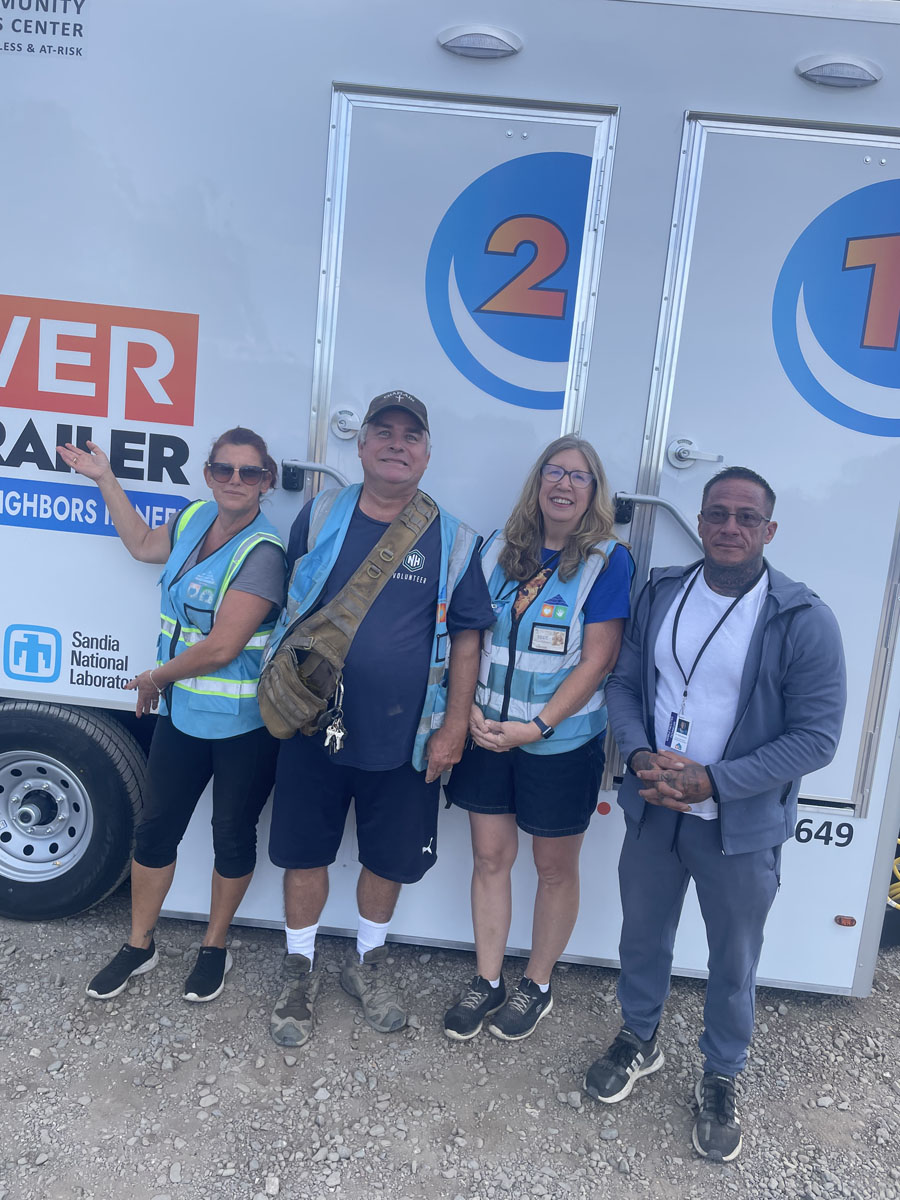
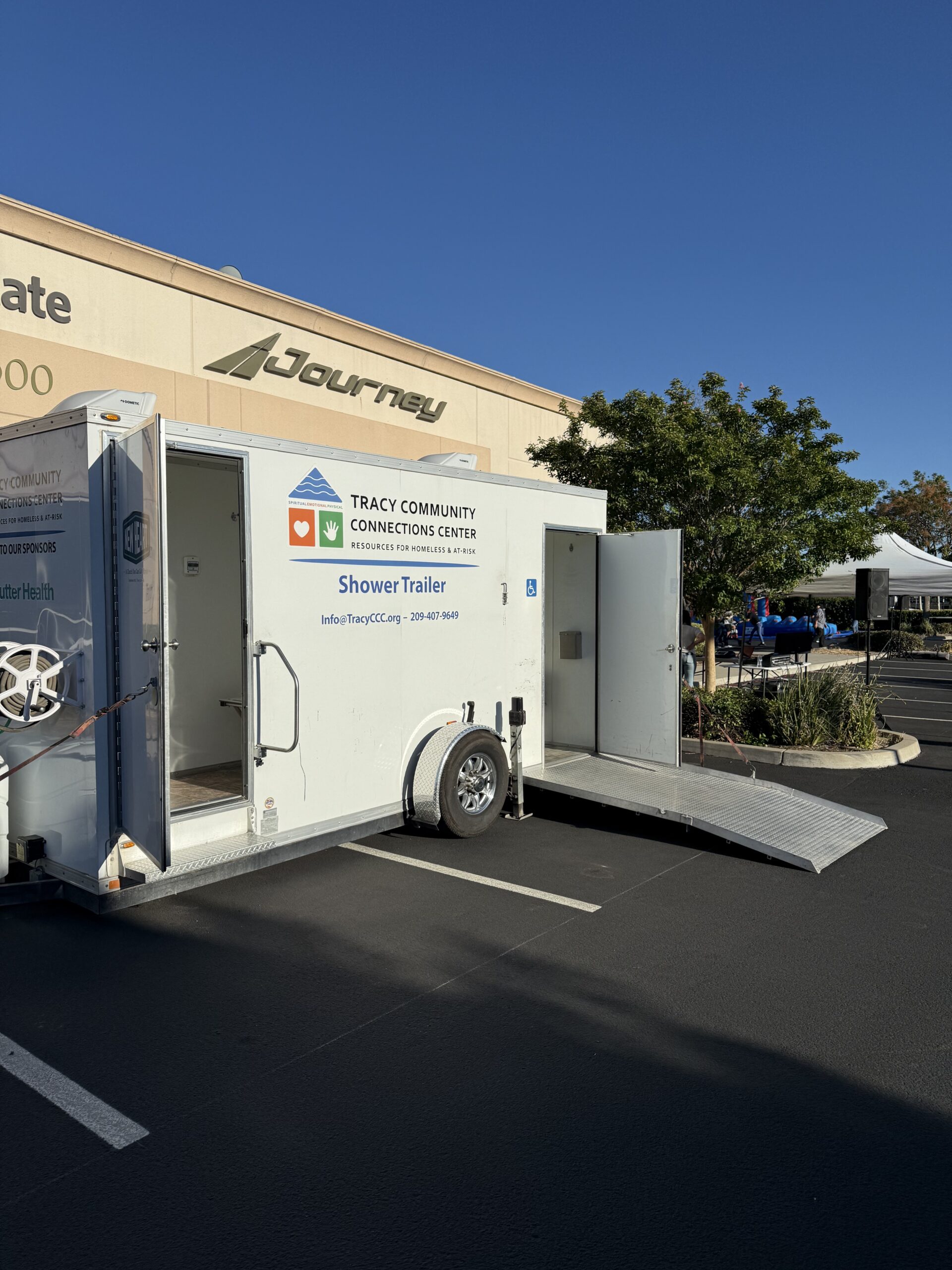
We’re excited to celebrate a new addition to Tracy Community Connections Center’s Mobile Shower Program! Our new shower trailer began serving the Tracy community on September 14th of this year, giving us the ability to provide even more people with access to a safe, clean place to shower.
The new trailer has three showers instead of two, allowing our team to serve more people during each mobile shower program. While adding another shower may seem like a small change, it means more community members can access an important service that supports health, hygiene, and dignity.
We’re especially grateful to our generous sponsors, Sutter, Sandia Foundation, and Raymus Foundation. Their support helped make this new shower trailer possible, and we couldn’t have done it without them.
The Mobile Shower Program is one of the ways TCCC works to meet people where they are and provide practical resources to members of our community experiencing homelessness. With three showers now available, we can reach even more people and continue building connections that can lead to additional resources and support.
Thank you to everyone who has supported the Mobile Shower Program and helped us grow. We look forward to celebrating this milestone with you!
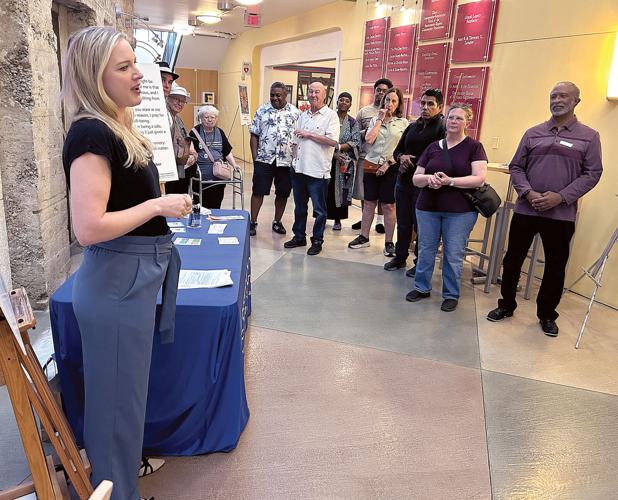
On August 29, 2026, Tracy Community Connections Center (TCCC) had the opportunity to bring the experiences and stories of local people experiencing homelessness into the spotlight through a special art show and film screening at the Grand Theatre Center for the Arts.
The centerpiece of the evening was an art project that grew out of TCCC’s mobile shower and laundry programs. While clients waited for a shower or for their laundry, volunteer Lynne Millar encouraged them to create artwork and write down thoughts about their experiences. The project gave people a chance to be creative while also sharing perspectives that are often overlooked.
Local photographer Casey Goodall became involved in the project and photographed about 20 people who volunteered to have their portraits taken. Six of those portraits were displayed at the event alongside artwork and written statements created by people who participated in TCCC’s programs.
For TCCC Executive Director Carrie Grover, the project was about more than creating something beautiful. It was an opportunity for people to feel seen and valued.
“What it really did was give them a sense that they were important, that they matter, that people care about them.”
That message was reflected in the portraits themselves. Goodall described the experience of photographing people and talking with them as surprisingly familiar and positive, much like being at a family gathering and simply getting to know people through conversation.
The artwork also showed how creativity can provide a meaningful outlet during difficult circumstances. TCCC chaplain and shower attendant Nathan Arbuckle shared the story of a man who had recently been hit by a car while riding his bicycle. When invited to create something, he chose to draw a guitar, something he was passionate about. For someone going through a difficult period, that simple opportunity to create became an uplifting experience.
The evening also highlighted what can happen when people have access to support, compassion, and opportunities to move forward. Grover shared the story of one woman featured in the project who had experienced homelessness in Tracy and had stayed in contact with TCCC. About two years ago, she decided to get sober. Today, she has a home in Stockton with her partner, works full-time, and helps care for her children and grandchildren. She now encourages others to pursue sobriety, housing, and employment.
Her story is an important reminder that homelessness is not the entirety of someone’s story. People can experience homelessness and later find stability, reconnect with family, build careers, and become sources of encouragement for others.
The art show also included a screening of No Address, a 2025 film about people experiencing homelessness and the circumstances that led them there. TCCC was one of the homeless service providers selected to receive proceeds from screenings of the film, and the organization was also given permission to show it for free in a group setting.
At TCCC, our work begins with meeting people where they are. Sometimes that means providing a shower or a place to do laundry. Sometimes it means connecting someone with housing, employment, healthcare, or other resources. And sometimes, it means giving someone a camera, a pencil, or a piece of paper and the opportunity to tell their story.
The art show offered our community a chance to see homelessness through a different lens that recognizes the people behind the circumstances and the dignity, creativity, and potential that every person carries with them.
There are moments in community work when something that may seem small from the outside represents an enormous step forward. At TCCC’s Shower Program, our growing team is creating more opportunities to support clients not only with basic needs, but also with the encouragement, relationships, and practical help they need to move forward. For one longtime client, that support recently helped lead to a milestone years in the making. Here’s an update from our Shower and Laundry Manager, Debbie DeGravelles:
We have so many positive things happening in our shower program. One of the biggest improvements has been expanding our team. John joined us as a case manager and has been an incredible addition. We also welcomed Danielle, a client/volunteer through Cal Works. Danielle has a special gift for making everyone feel welcome. She is a friend to everyone and helps create a warm, encouraging environment.
Because of these new team members, we have been able to surround our clients with support in ways we couldn’t before.
One client’s story especially stands out:
R.A. has been living on the streets since he was 10 years old. He left school at that age and has spent most of his life surviving without the support many of us take for granted. Some have even described him as “feral.” He has been using our services for more than five years, and throughout that time we have continued to encourage, support, and believe in him.
Although R.A. is around 40 years old, he had never been able to obtain a state ID. Without identification, many opportunities remained out of reach.
Recently, R.A. began helping our team with setting up and tearing down the shower program each week. Having this responsibility has given him a sense of purpose and helped him feel like a valued part of the Tracy Community Connection Center family.
For years, we encouraged R.A. to get his ID, but he faced many barriers that prevented him from doing so. With the support of our expanded team, we were finally able to help him overcome those obstacles. Our outreach team provided transportation to the DMV, and another client accompanied him so he wouldn’t have to face the process alone.
This week, R.A. received his state ID in the mail.
This simple piece of identification represents so much more than a card. It opens the door to employment, housing, benefits, banking, and many other opportunities that were previously out of reach. We know R.A.‘s journey isn’t over, but this is a major milestone.
We are grateful to celebrate this victory with him and remain committed to walking alongside him as he continues building a brighter future.
R.A.’s new state ID is more than a piece of identification. It represents new possibilities. With his ID in hand, doors to employment, housing, benefits, banking, and other opportunities can begin to open. We know his journey is still unfolding, but we are proud to celebrate this important step and grateful to be able to walk alongside him. As Debbie and the Shower Program team have seen time and again, progress can take time, but patience, persistence, and a community willing to believe in someone can make a meaningful difference.
Every two years, communities across California participate in the Point-in-Time (PIT) Count & Report, a federally required effort to better understand homelessness in our region. The results help guide funding decisions, identify community needs, and measure whether local programs are making a difference.
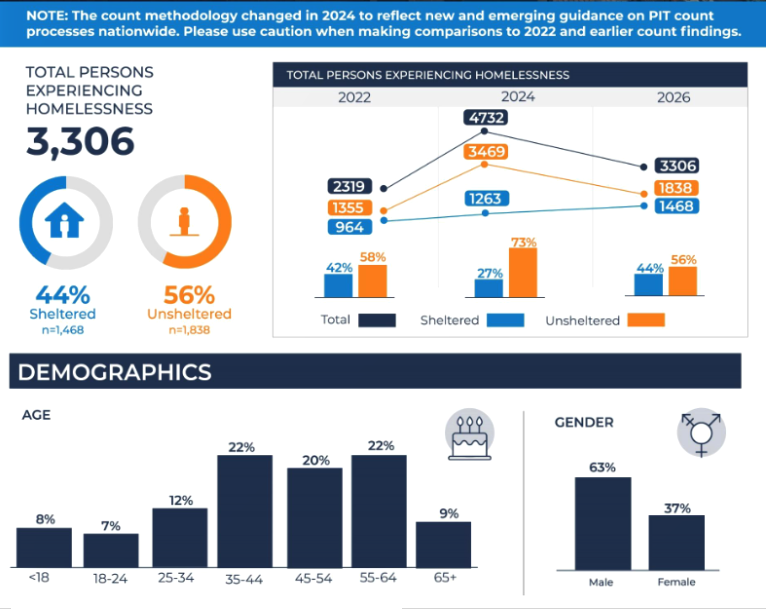
The newly released 2026 San Joaquin County Homelessness Point-in-Time Count (view the full PDF at the bottom of this post) offers both encouraging news and important reminders about the challenges that still exist. At Tracy Community Connections Center (TCCC), we see these realities every day through our outreach, case management, housing navigation, and homelessness prevention programs.
There Is Good News
One of the most encouraging findings is that overall homelessness in San Joaquin County decreased compared to the 2024 count. While there is still significant work ahead, this suggests that the combined efforts of nonprofits, local governments, housing providers, volunteers, and community partners are making an impact.
The report also found a decrease in the number of veterans experiencing homelessness. Veterans often face unique challenges after military service, and continued collaboration between veteran service organizations, housing providers, and local nonprofits appears to be helping more veterans access stable housing and support.
These improvements remind us that homelessness is not an impossible problem. With the right resources, partnerships, and long-term commitment, positive change is possible.
Just one part of the comprehensive report. We recommend reading through the full report PDF below.
Most People Experiencing Homelessness Are Already Part of Our Community
One statistic that stands out in this year’s report challenges a common misconception. Many people assume that individuals experiencing homelessness moved here from somewhere else. In reality, the report shows that the overwhelming majority of people experiencing homelessness were already living in San Joaquin County before they lost their housing.
These are our neighbors. They’re people who grew up here, worked here, raised families here, attended our schools, or lived in our communities for years before experiencing a financial crisis, job loss, illness, or another life-changing event. Understanding this helps shift the conversation from “outsiders coming in” to recognizing that homelessness often affects people who were already part of our local community.
The Biggest Barriers Are Economic
Another important takeaway from the report is what people identified as the primary obstacles to finding permanent housing. The leading barriers were overwhelmingly economic, including:
High housing costs
Low wages
Lack of affordable housing
Insufficient income to cover rent and living expenses
This is significant because it challenges another common stereotype that homelessness is primarily caused by drug use or mental illness. While behavioral health and substance use can absolutely affect some individuals and deserve compassionate treatment, the Point-in-Time Count shows that the most commonly reported barriers to housing are financial. For many people, the math simply doesn’t work. Rent continues to rise while wages struggle to keep pace.
Why Prevention Matters
These findings reinforce something we’ve talked about before on our blog: preventing homelessness is often more effective than responding after someone has already lost their housing.
When someone receives help before an eviction, connects with housing resources early, or works with a case manager during a financial crisis, they may never have to experience homelessness in the first place. At TCCC, we work every day to provide case management, housing navigation, eviction prevention assistance, resource referrals, street outreach, and connections to healthcare and community services. Every successful intervention represents someone who has a better chance of remaining safely housed, or returning to stable housing more quickly.
The 2026 Point-in-Time Count offers reasons for optimism while also reminding us that affordable housing and economic stability remain major challenges throughout San Joaquin County. Progress is happening, but it takes continued collaboration between nonprofits, local governments, businesses, volunteers, donors, and community members to keep moving in the right direction. Every person who finds stable housing, every veteran who receives support, and every family that avoids homelessness represents meaningful progress for our community. At Tracy Community Connections Center, we’re grateful to be part of that work every day, and we’re committed to continuing to serve our neighbors with compassion, dignity, and hope.
Every year, National Nonprofit Day is an opportunity to recognize the organizations, volunteers, donors, and community partners who work every day to make a difference. At Tracy Community Connections Center (TCCC), it’s also a chance to reflect on what can happen when a community comes together to support its neighbors. Nonprofits exist because some of our communities’ greatest challenges can’t be solved by one person or one organization alone. Whether it’s preventing homelessness, helping someone recover after a hospital stay, providing access to showers and laundry, or connecting families with housing resources, lasting change happens through collaboration.
People often think of nonprofits simply as charities that provide services. While that’s certainly part of what we do, nonprofits also build relationships, strengthen communities, and create opportunities that have lasting impacts. At TCCC, our work extends far beyond meeting immediate needs. We help individuals obtain identification, apply for benefits, connect with healthcare and behavioral health services, prevent evictions, find housing, and rebuild stability after difficult circumstances. Every success story represents countless hours of case management, outreach, coordination, and follow-up.
Many of the people we serve are working, caring for family members, recovering from illness, or facing unexpected hardships. Our role is to help them navigate those challenges and move toward long-term stability.
Behind Every Service Is a Team
Earlier this year, we wrote about the nonprofit overhead myth and the misconception that a nonprofit’s value can be measured simply by how little it spends on administration. The reality is that every shower provided, every outreach visit completed, every housing placement, and every successful case depends on dedicated staff, trained volunteers, reliable vehicles, technology, office space, insurance, and countless behind-the-scenes operations. These aren’t distractions from the mission but what make the mission possible.
When you support a nonprofit, you’re supporting the people and infrastructure that allow life-changing work to happen every single day.
The Community Makes Our Work Possible
Our organization has never worked alone. This year alone we’ve been blessed by partnerships with businesses donating food, hotels providing towels for our Mobile Shower Program, organizations supporting community food distributions, volunteers giving their time, churches opening their doors, and countless donors who quietly make our work possible. Every donation, volunteer hour, referral, and encouraging conversation helps someone take another step toward stability.
Imagine a Day Without Nonprofits
In another recent post, we explored what our community would look like without nonprofit organizations. It’s a powerful reminder that nonprofits fill essential gaps that many people rely on every day. Without organizations working together, many individuals would struggle to access basic necessities, emergency assistance, housing navigation, food, healthcare referrals, transportation, and other critical services. National Nonprofit Day reminds us that these services don’t exist automatically, but because people choose to invest in their communities.
Today, we’d like to thank everyone who has been part of TCCC’s journey.
To our staff who work tirelessly behind the scenes.
To our volunteers who generously give their time.
To our board members who provide leadership and guidance.
To our community partners who collaborate with us every day.
And to every donor whose generosity allows us to continue serving our neighbors.
Happy National Nonprofit Day, and thank you for helping make our mission possible.